Main
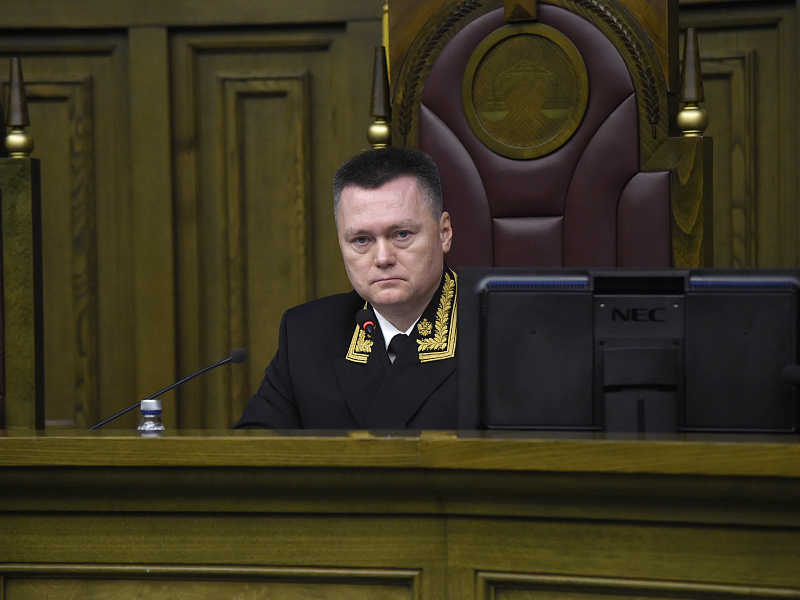
Under the chairmanship of Igor Krasnov, the Plenum of the Supreme Court on November 25, 2025 examined important aspects of Russian justice
The draft was developed because the institution of state fees plays a crucial role in realizing the right to judicial protection, ensuring the independence of the judiciary, and serving as one of the means to achieve the goals of justice.
Furthermore, Federal Law No. 259-FZ of August 8, 2024, "On Amendments to Parts One and Two of the Tax Code of the Russian Federation and Certain Legislative Acts of the Russian Federation on Taxes and Fees," introduced significant changes to the legislatively established model for regulating relations arising from the payment of state fees in court proceedings.
A distinctive feature of the legal regulation of state fees is the systematic application of the provisions of procedural, tax, and budgetary legislation. The correct application of these provisions should ensure a balance between the obligation of everyone to pay statutory fees and the right to judicial protection guaranteed by the Constitution of the Russian Federation.
The document places particular emphasis on provisions that highlight the most important social aspects of Russian justice and ensure the applicant's right to judicial protection.
For example, paragraph 3 clarifies that when an individual entrepreneur files a lawsuit, the state fee is paid at the rate established for individuals, i.e., a smaller amount than the state fee paid when an organization files a lawsuit.
Furthermore, based on the fundamental principles of tax and fee legislation, and taking into account the principle that all unresolved doubts, contradictions, and ambiguities in tax and fee legislation are interpreted in favor of the taxpayer, the document clarifies that no state fee is paid when filing a petition to correct clerical errors, typos, and arithmetic errors, a petition for the award of a penalty, or a petition for indexation of awarded monetary amounts.
It is important to note that the draft only addresses the most general, relevant legal aspects of paying state fees when considering cases in civil, arbitration, and administrative proceedings. At this stage, the clarifications do not address issues of deferrals, installment plans, exemptions from paying state fees, or reductions in their amount, nor payment of fees for certain types of applications. Work on these issues, as instructed by the Chief Justice of the Supreme Court of the Russian Federation, will continue.
Following the discussion, an editorial committee was established to consider the comments and suggestions received.
In addition, the Plenum of the Supreme Court of the Russian Federation considered a draft resolution "On Amending Resolution No. 58 of the Plenum of the Supreme Court of the Russian Federation of December 22, 2015, 'On the Practice of Imposition of Criminal Sentences by the Courts of the Russian Federation.'"
The document proposes to introduce significant clarifications to the resolution, which was adopted in 2015, taking into account the latest amendments made in 2018. Thus, the Supreme Court of the Russian Federation emphasizes the need to update previously provided clarifications to the courts and bring them into line with current legislation.
The proposed amendments apply not only to the imposition of actual imprisonment but also to such types of criminal punishment as fines, deprivation of the right to engage in certain activities, deprivation of special, military, or honorary titles, class ranks, and state awards, restrictions of liberty, and correctional and forced labor, the application of which does not involve the isolation of the convicted person from society.
Currently, forced labor, as an alternative to imprisonment, is assigned only by replacing a convicted person's sentence with imprisonment, while correctional labor is assigned to convicted persons, whether they have a primary job or not.
In connection with amendments to the Criminal Code of the Russian Federation, starting January 20, 2026, forced labor will be a separate primary type of punishment, and correctional labor will only be possible if the convicted person has a primary job. These amendments expand the courts' ability to impose forced labor and resolve issues arising during the execution of correctional labor.
The draft also provides clarifications regarding the possibility of assigning the above-mentioned types of punishment to foreign citizens and stateless persons. Amendments are proposed regarding the procedure for imposing restrictions on freedom.
The draft provides clarifications regarding the courts' consideration of mitigating and aggravating circumstances, the establishment of which affects the sentencing of a person who has committed a crime. Certain amendments concern the consideration of mitigating circumstances such as the presence of minor children when determining a sentence, and the application of a new aggravating circumstance—committing a crime by a person illegally residing in the Russian Federation.
Following discussion, the draft resolution was sent to the editorial committee for revision.