Main
Igor Krasnov took part in the plenary session of the Council of Judges of the Russian Federation
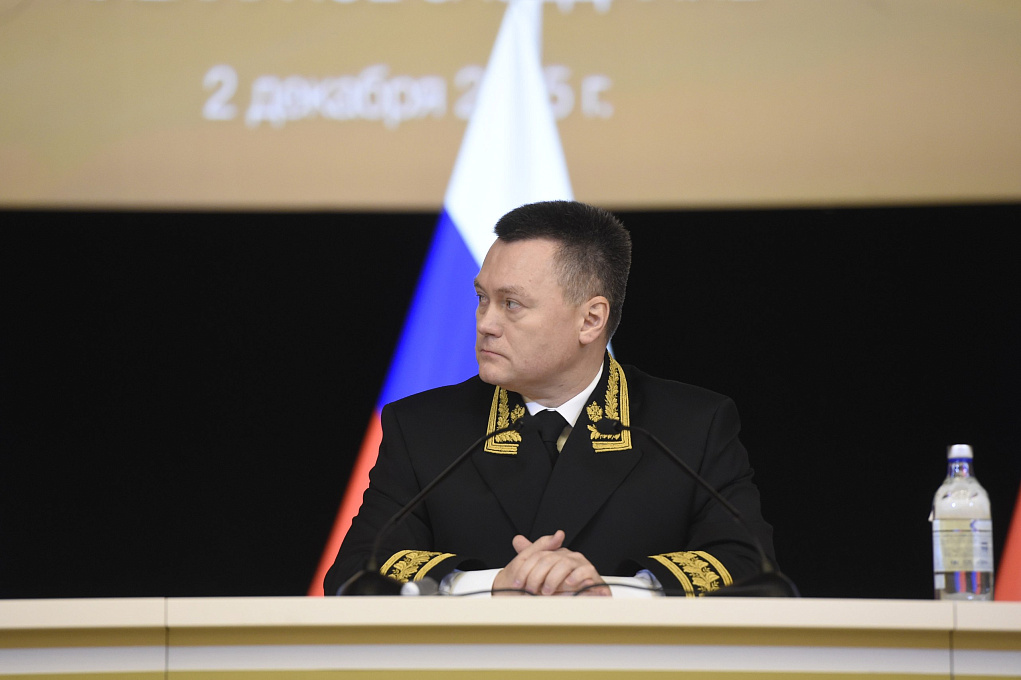
Addressing the judicial community, the Chief Justice of the Supreme Court of Russia noted that this year, the country's judicial system continued to develop amidst a changing spectrum of social relations and the prompt resolution of critical state issues.
Over the past 11 months, courts at all levels heard over 25 million cases. The quality of justice, as in previous years, remained consistently high overall.
"At the initiative of the Supreme Court, a number of regulatory decisions have been adopted aimed at streamlining judicial proceedings and increasing their efficiency. These include the establishment of extrajudicial collection of tax and fee arrears from individuals, a new appellate mechanism in civil proceedings, and several other innovations", Igor Krasnov explained. Most of these are aimed at effectively reducing the judicial workload, which remains extremely high in some regions of the country. The Chairman of the Supreme Court of Russia noted that the highest workload figures are recorded in Moscow and the Moscow Region, St. Petersburg, Krasnodar Krai, Tyumen Region, the Khanty-Mansi Autonomous Okrug, and several other regions.
"I have issued instructions to redistribute vacant positions in the country's courts within the limits of the staffing levels established by law. The necessary organizational decisions will be made based on a detailed analysis of the collected data", the Head of the Russian Judiciary said.
He added that the workload figures are also affected by the presence of excessively cumbersome bureaucratic procedures in the judicial system, as well as the volume of work unrelated to the administration of justice. For example, the collection of a significant array of indicators, many of which have lost their practical significance but continue to require the time of judges and staff.
"In this regard, an audit of the statistics compiled and an analysis of the document flow have been instructed to eliminate repetitive operations, ineffective templates, and reporting forms". "Courts must be relieved of excessive, especially inappropriate, burdens", concluded the Chairman of the Supreme Court of the Russian Federation.
Igor Krasnov also stated that one of the pressing challenges, the solution of which is directly linked to the level of social and economic stability and public trust in the judiciary and the state as a whole, is improving the quality of judicial decisions and their focus on serving society.
"They should not contain innuendos or unsubstantiated value judgments, nor should they create ambiguity of interpretation, much less serve as a catalyst for fraudulent and other illegal schemes. Unfortunately, such instances do exist. Making decisions to please regional and local authorities or to serve the interests of corporations and commercial entities is unacceptable. The response to any corrupt actions—regardless of the level—will be uncompromising", he said.
According to Igor Krasnov, judicial practice should be formed solely on the basis of the law and the legal positions of the Supreme Court, expressed in reviews and official judicial interpretations. To this end, the work of the Presidium of the Supreme Court has been intensified; its role in making practice-forming decisions will be key.
Regarding analysis, Igor Krasnov explained that next year, a summary of judicial practice in anti-corruption cases related to unauthorized construction, bankruptcy, corporate property taxation, the application of customs legislation, and a number of other relevant issues is planned.
"I see the Supreme Court's task as enforcing a clear, logically consistent line in the acts and decisions it issues. These decisions must be understandable not only to judges, but also to the entire legal community, citizens, and businesses. They must be promptly adjusted where necessary due to changes in laws". "The country's highest judicial authority must and will speak clearly, and the courts will hear this position in its precise and official form", the Chairman of the Supreme Court of the Russian Federation emphasized.
At the same time, Igor Krasnov noted that in the current environment, courts are required not only to deliver quality justice, but also to be efficient and technologically advanced. This is because the judicial system is both the guardian of legal traditions and the driver of modernization of law enforcement based on modern scientific approaches, digital technologies, and best international practices.
"We will certainly do this work together", he said.
In conclusion, the Chairman of the Supreme Court of the Russian Federation thanked the judges for their daily contribution to strengthening justice in our country and wished productive work to all members of the Council of Judges of the Russian Federation.
At the event, which brought together approximately 150 representatives of courts of all types and levels – from the Supreme Court to the Magistrates' Courts – the candidate for the new head of the Council of Judges was considered. Mikhail Ptitsyn, Chairman of the Moscow City Court, was appointed. Furthermore, Igor Krasnov appointed Gennady Lopatin to the position of Director General of the Judicial Department at the Supreme Court of the Russian Federation.
During the plenary session of the Council of Judges of the Russian Federation, issues of judicial ethics as a factor in fostering anti-corruption legal awareness in the judicial community, as well as current issues in the Magistrates' Court, were discussed. Natalia Burashnikova, Chairman of the Tambov Regional Court, delivered a report on this topic. Elena Suvorova, Chairperson of the Oryol Regional Court, briefed the audience on current issues in the justice system.
The Council of Judges of the Russian Federation also considered the election of nine new members. These included representatives from the Supreme and Constitutional Courts of the Russian Federation, the courts of the Tomsk and Kirov Oblasts, and the Republics of Buryatia and North Ossetia-Alania.
The Council of Judges of the Russian Federation has been operating in Russia since 2002 and is an elected body of the judicial community. It is formed by the All-Russian Congress of Judges from among judges of federal courts, as well as courts of the constituent entities of the Russian Federation.
Plenary sessions of the Council of Judges of the Russian Federation are convened as needed, but no less than twice a year. The working body of the Council of Judges of the Russian Federation is the Presidium, which is created to promptly resolve issues collectively and is convened no less than four times a year.
The Council of Judges of the Russian Federation also elects from among its members the Chairman of the Council of Judges of the Russian Federation and his deputies, who are accountable to it and who also serve as heads of sections (courts of general jurisdiction, arbitration courts and military courts).